Too often we define the Medtech sector by the number of dollars raised, IPOs helped or companies sold. But the focus neglects the very foundation of the sector: the people. Join the Medtech Talk Podcast each month to hear from entrepreneurs, investors and executives who spend their days developing the tools that make sick people well and health care more efficient.
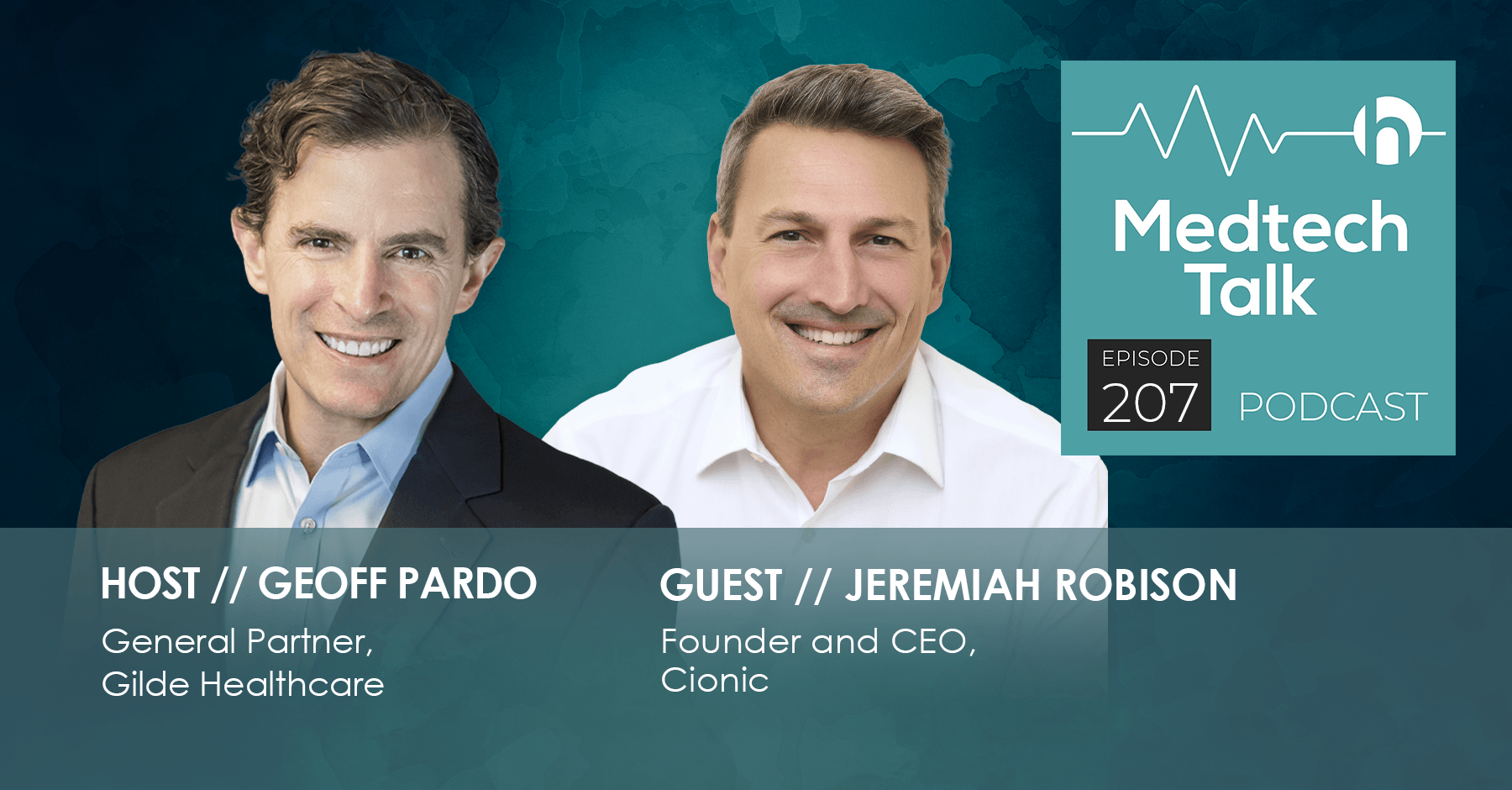
“Assistive” devices are often bulky, but not the one Jeremiah Robison, founder and CEO of Cionic, has developed. His company’s FDA-cleared Neural Sleeve is worn on the leg and combines wearable sensors, machine learning, and functional electrical stimulation to improve gait for people dealing with foot drop, spasticity, and other mobility-limiting neurologic conditions. Host Geoff Pardo shares a very personal story of a spinal procedure that took away much of his right-side mobility and how the Neural Sleeve has helped with his recovery. Robison also shares the origins of the technology, starting with his daughter’s cerebral palsy diagnosis. Their conversation breaks down how the system works, including IMUs for gait kinematics, surface EMG for muscle signals, and why precise timing in the walking cycle changes everything.
GUEST BIO
Jeremiah Robison, Founder and CEO, Cionic
Jeremiah Robison is the founder and CEO of Cionic. A Silicon Valley technologist and entrepreneur with a career spanning Apple, Openwave, Slide, and Jawbone, Jeremiah has dedicated his professional life to creating products that shape how people live, connect, and perform. That journey took a deeply personal turn when his daughter was diagnosed with cerebral palsy. Confronted with the reality that mobility solutions had barely advanced beyond crutches and wheelchairs, Jeremiah set out to build something radically better. In 2018, he founded Cionic with a bold vision: to harness the power of software, hardware, and machine learning to restore movement across the entire human body, starting with walking.
Today, under his leadership, Cionic is pioneering wearable neurotechnology that adapts in real time to the body’s needs, bringing independence and new possibilities to millions of people living with mobility challenges. Jeremiah earned his master’s degree in computer science from Stanford University.
HOST BIO
Geoff Pardo, General Partner, Gilde Healthcare
Geoff Pardo is a general partner leading Gilde’s U.S. investments out of Boston. He led the investments in Inari Medical, Axonics Modulation Technologies, CVRx, Eargo, InovaLabs, among others, serving on the board of each company. Most recently, he served in these capacities for Alleviant Medical, Mainstay Medical, Ablative Solutions, and GT Medical. Previously, he was a partner at Spray Venture Partners, where he led investments in Interlace Medical, Solace Therapeutics, TearScience, and Cascade Ophthalmics. Geoff also served as president and CEO of Facet Solutions, a spinal implant company focused on treating lumbar spinal stenosis. He has also worked at Cardinal Partners as an associate leading their investing activity in the medical device sector. Geoff began his career in medical devices as a product manager with Synthes USA.
He has a bachelor’s degree with honors in history from Brown University and a master’s degree in business from the Wharton School of Business. He is based in Gilde Healthcare’s Cambridge, Massachusetts office. Geoff is also chairman of Advamed’s medtech investor working group, which focuses on the key issues that affect emerging medtech companies and the investors which support them.
TRANSCRIPT
Welcome to the Med Tech Talk Podcast. This is your host, Geoff Pardo, and today I'm joined by Jeremiah Robeson, the founder and CEO of Cionic, a company that is reimagining what's possible in human mobility through wearable neurotechnology. Jeremiah is a Silicon Valley technologist and entrepreneur who spent much of his career working at the intersection of technology, data, and the human body, including roles at Apple, OpenWave, Slide, and Jawbone. But his decision to start Cionic was a deeply personal one. His daughter was diagnosed with cerebral palsy, and Jeremiah saw firsthand how limited the available mobility technology was. That experience led him to ask a pretty remarkable question. What if we could use software, sensors, machine learning, and electrical stimulation to actually help the body move better? Today, Cionic's FDA-cleared Neural Sleeve is doing exactly that, helping people with neurologic conditions improve their mobility and independence. And in an interesting twist here, I'm also a patient of the Neural Sleeve. Following a difficult spinal procedure, I lost a lot of mobility on my right side, and I've been using the neural sleeve as part of my recovery. We can get into that and more in this episode. Jeremiah, welcome to the podcast. It's great to have you here.
Jeremiah RobisonThank you, Geoff. Thank you so much for having me.
Geoff PardoWell, great. Yeah, so there's so much to cover here. I mean, and you never want your your professional life and personal life to intersect too much. In my case, it has, but I've really, you know, it's been an amazing experience using the technology. So we're going to get into that and and the whole journey with Cionic. But to start out, what I'd love to hear is more of your backstory. You know, how did you grow up? Where did you grow up? What were your early interests? Did you have a sense that you were headed towards a life of entrepreneurship? Maybe we get started there.
Perfect. Yeah.
Jeremiah RobisonAnd your introduction was such a good, you know, a way to introduce the journey that I've been on. And, you know, honestly, I feel like this path chose me. I grew up in a house where my mother was a physical therapist and my father was a computer scientist. She was an entrepreneur. She ran her own clinic, spine-based therapy clinic, helping people to recover from injury and disability. And, you know, very early on, I had, you know, her passion for the body and helping individuals and my father's innovative side. And that led me to Stanford University, where I got a bachelor's and master's in computer science, actually was focused on algorithms. So early, early machine learning, which took me to Apple Computer, where I worked on their first handheld computer, the Newton, back in the late 90s, doing handwriting recognition. So interpreting signals from the body using machine learning, all the way back when it was done in assembly code. I went from there to open wave systems, where I built the first web browser for cell phones. And we shipped a billion of those worldwide before there was an iPhone and before there was Android, really laying the foundations of the early web and really solidifying my love for mobile computing and embedded systems. And I went from there to see, you know, in some ways how the other half lived. I got introduced to Max Lemchin of PayPal fame. And uh, I really wanted to learn how to be an entrepreneur and an entrepreneur technologist, and he's one of the best. And we started Slide, which we ended up having four different properties with 10 million monthly active, serving over a billion photos a day. So really large-scale data systems and understanding the power of data and predictive systems to you know dictate human behavior. And just after we sold that to Google, I decided I wanted to take all of those learnings and apply them back to the world of health. And I started a company really trying to match up coaches, trainers, and nutritionists to clients using gamification to help them achieve their goals. I ended selling, set ended up selling that company to Jawbone, where it became all of the software infrastructure for their wrist-worn tracker. So the up band, which was the first of the wrist-worn trackers. And you know, that was amazing. I through that experience, I actually learned hardware. I ended up running both hardware and software there over time.
And just after selling my company to them, my daughter was diagnosed with cerebral palsy. So, you know, early traumatic birth scenario, very common with cerebral palsy. She was born three months premature, two pounds, four ounces, not breathing. But we didn't get her in her diagnosis till about a year after she was born when she started missing some of those physical milestones. And, you know, for the next six years, it was like, gosh, there has to be something to help her with her mobility and her independence. Um, look at what we're doing. Anything is possible through technology, and you know, the best that the medical world had to offer us were crutches and walkers and rigid bracing. So 2018, I stepped down, yeah, Silicon Valley fairy tale, went into the garage, started building prototypes, testing them with her, and uh Cionic was born.
Geoff PardoThat's incredible. And so what were the you know, what were some of the symptoms you were looking because I know was cerebral palsy? There's a lot of spasticity, right? There's so what were some of the things that you were focused on in those early days to try and help her?
Jeremiah RobisonYeah, so cerebral palsy, the most common childhood motor disability, it can be pretty wide-ranging, but typically it happens because of some damage during birth to the to the brain, to the motor. And it starts primarily with the motor cortex, and so you lose coordination first of the lower extremities, then the upper extremities, and as they get more and more severe, you start to lose things like ability to eat and swallow and ability to do language. And so we're really fortunate. Our daughter is uh what's she's mildly impacted, and she her primary challenges are you know with her disability. And as you said, spasticity and tone are large challenges with her. And what was interesting at the time we were trying a lot of different mobility devices, mobility solutions. And I do think that one of the biggest challenges is understanding the overall complexity of the motor neurosystem.
So we actually started out, I started out by measuring the kinematics of gate using IMUs and the muscle firings using surface EMG to try to get a better understanding of what I would say is the cause, you know, how are the muscles firing and the effect, how is the body moving through space. And that was really the the first set of technologies that we were building out to really see if we can measure it. So if we can measure it, then we can impact it. But that was the start.
Geoff PardoYeah, that's amazing. And I know, you know, and I'm wearing it, I'm wearing it right now, actually, and uh, you know, typically I'll wear it, you know, four or five hours at kind of every other day. And you know, as I explain it to people, because you do get a lot of questions as you as you wear it, you know, the it it the remarkable thing is that it is stimulating the muscles at at precisely the right moment as you move through your walking cycle. And in my case, you know, drop foot is an issue, tone and spasticity is an issue, and you know, it helps keep my my the toe of my foot up as I swing my leg through the cycle. And it seems, you know, like I guess all great inventions, it seems remarkably simple. You know, it's just a sleeve you put over your leg, but I imagine there was a lot of things you had to work through in order, you know, you mentioned measuring, but as you started to come up with those early prototypes, what were the what were the things that you had to really overcome and and figure out as you went
through it?
Jeremiah RobisonOh yeah, thank you. I one of the really interesting things as we started out, you know, having my daughter going through this lived experience and trying to understand the complexity of her condition, you know, the what we we were actually trying interventions like electrical stimulation in physical therapy. And you know, it was they have a machine and they spend a bunch of time trying to find the right placement of the electrodes, and then they would walk behind her, and literally the physical therapist had two buttons in her hand, and she would push one and then the other when she wanted the specific muscles to fire. And I was like, okay, wait. So we're currently limited to how well you can figure out how to place these electrodes, and you know, the the power of observation and the speed with which she could click the buttons and said, Okay, this seems like a perfect opportunity. At the same time, we had just gone down to Stanford University and they had wired her up with you know the little reflective dots and the EMG sensors to basically do a gate report. It was an hour-long setup and then, you know, 10 steps across force plates and back. And we're like, oh, okay, great. Uh, here's a stack of papers that says how to how she could walk. So it was, you know, we had these two technologies that seemed really promising. One, let's understand a real-time picture of her gate, and two, electrical stimulations ability to act. So, how could we make it something that could be used every day and could really attack the diversity of condition? And so, you know, we started out first looking at timing. And what was really interesting for my daughter was, you know, the things that existed on the market at the time were single muscle or dual muscle stimulators. And as we started to really understand how to activate a larger number of muscles at a time, it wasn't just incremental, it was really these sort of exponential changes as we went from you know, stimulating just the tibia for or the tibialis anterior for foot drop, to being able to stimulate the gastroc for push off, the hamstring for knee flexion, the quad for knee extension. We started to see these really profound changes. And because we were measuring those kinematics, we in real time we could really show that we were able to do you know really meaningful changes to her gait. And then we said, okay, great. So we were able to do that with still doing manual electrode placement. We said, well, look, can we take that two electrode and turn it into an array of electrodes and use software to steer that electrode array? And so turning a problem that's usually a hardware or a mechanics problem of placing those electrodes and actually turn that into a software problem. So we we we built these electrode arrays and actually through time slicing across these arrays, we were able to basically create virtual electrode shapes of kind of any dimension that we needed within that array. And uh, and that would allow us to do complex movements. Like many people who have foot drop also have problems with inversions. So not only are they not able to lift the foot, but their ankle's kind of turning in, giving a you know, sort of a rolling ankle at footfall that's also you know dangerous for falls. So, you know, once we were able to get the timing right, and then we were able to get this uh array-based interface, right? Then I say, how do we integrate it into something that people will wear every day?
And I remember talking to you, Geoff, and you're like, when I first saw this thing come out of the box, it was very intimidating. But we worked with some of our, you know, we have a partner, uh, a really great design firm called Fuse Project. And we worked with them and with our patients to try to design something that was able to be donned and doffed independently, and you know, with even with one hand, because a lot of our patients have upper limb mobility issues as well. So, you know, I think those were sort of the first set of innovations, something that you could wear, something where we turned a lot of the hardware problems into software problems, and one and the third of just really being able to adapt to different gate cycles. And, you know, we did a we'd really built up a a tremendous stack to get that first device into the FDA. Yeah.
Geoff PardoYeah, it's pretty remarkable. And you and I have also chatted about, you know, that I mean, there's so many things, not not that they're really that technologically complex, but there's so many things that are utilized in the physical therapy or occupational therapy environment. But to then translate that to outside of the of the facility, really take something that, you know, kind of fits into people's daily lives. You you you're probably not gonna walk around with things with wires, you know, hanging out all over the place where they can be pulled, pulled off or whatever. You just look, you know, you look a little out of place, I guess. And I think that's what's elegant here is that you know it it looks a lot like an you know a neoprene sleeve that you put over your your knee. So was that was that the original conception, or or did it take you a while to get to something that you know just fit seamlessly into someone's life outside of you know a PT or OT center?
Jeremiah RobisonYeah, I remember because I still have the first prototype of just the sensing sleeve, and it was using a neoprene knee brace. And you know, I I do have my daughter to thank a lot for that. She said, It look, if if it looks like you know, something that is medical or something that is, you know, big and bulky, I just won't wear it. And you know, I I think that both represents an opportunity and some challenges. I think my background working in consumer health was, you know, reinforced a lot of that. Like we really want to make it small and lightweight and you know, comfortable to wear. And so it was always part of the you know overall mission. And I also wanted to make it feel like it wasn't less than. I think a lot of you know, a lot of individuals who have an injury or disability, you know, they they get viewed as less than. And when they talk about why they don't use their assistive equipment, it's like it has a stigma around it. They don't want people to be asking them questions. So, you know, the I I liken it to, you know, those single sleeves that they see on MBA players and really thinking of it as our ambition as being, you know, greater than as something aspirational. So we're we're you know, we're just getting started, we're not there yet, but you know, that's the that's the main push for building something that looks good and people can wear, wear it under clothes if they want, or they can show it off if they want.
Geoff PardoYeah, yeah, no, absolutely.
So so once you sort of had it working, you had it, you know, the the the pathway was a 510K pathway, was that right, through FDA? Yeah, that's right. And and uh when did you start kind of the clinical work or sort of broadening the experience to get, you know, to start to gather all this data? Maybe talk a little bit about that and what you learned through that clinical experience.
Jeremiah RobisonYeah, I mean it started pretty early, even with just the sensing system. We had a partnership here with Stanford University where they were using it to try to measure kinematics and EMG as signals of disease progression. And then we, you know, once we got the stimulation side of the system up and running, we were out shopping for clinical partners to run our first trial. And just as we were getting started, COVID hit. But this was actually a really interesting opportunity for us. We decided if we were going to run any trials at all, we would have to do them virtually. So we built a telehealth layer into the system itself. It allowed us to look at, you know, both of the biological signals coming off of the device in kinematics and muscle firings, also set up the system and tune it according to what the users needed. And we started actually running trials through you know, through that system, and we were able to make a tremendous amount of progress. And it turned out that this was an essential part of our overall system. And so one of the things that we learned, and you know, I think this is where all device and probably some drug device systems need to go, is they need to be able to have continuous real-time monitoring of individuals and be able to adjust these things on the fly. If you have to wait six months for an appointment to go into your doctor to get it adjusted, it's just too long. And so, or if you know someone doesn't know that it's not working for them and they need it to tune up, how do we flag these things? So, you know, that has been a big boon for us. But as soon as COVID started to back off and vaccinations were available, we were able to get into some labs. We partnered with Cleveland State University on our first trial, really looking across the populations of foot drop and really measuring that, you know, toe lift and ankle inversion. And we've just continued to build up evidence over time. Probably the thing I'm most excited about right now on that side is that our partners, UCSF, were just awarded an NIHR1 grant to study the sleeve longitudinally over nine months, sham controlled in the MS population, 70 people, and really understand the longitudinal impact of the sleeve. And and you know, it those timelines take a long time, but you know, that study was really built off of work that Dr. Plock at UCSF, who is the the PI on that study, did two years ago. Again, looking at the real-time data off of the sleeve and in a gate environment, a gate lab environment, to see what were they able to improve gate stability. And so they were looking at footfalls. And so she has these really amazing graphs where you see an individual, you know, without our intervention, really kind of just dragging their foot behind them, and then in a single session with four muscle stimulation, again, the ability to address more of the underlying neuromuscular challenges, almost a normal restoration of footfall, a full uh crossover step through gate. So, you know, obviously there is a lot to investigate between the different populations that we have and within the different segments, and all of that continues to be ongoing work internally and with academic research partners.
And I wanted to ask, you know, what are the populations that, you know, obviously we talked about cerebal palsy with your daughter, my condition, which is more of a spinal cord-related issue, but I imagine those are probably not the most common, or are they? Which which are the different populations that this is most effective for?
Jeremiah RobisonYeah, so our FDA clearance is for upper motor neuron conditions, and that includes multiple sclerosis, post-stroke, cerebral palsy, spinal cord injury, and a fairly long tail of unique both genetic and you know injury-based disabilities. Our largest population is multiple sclerosis, although the largest, you know, overall population of individuals that we can help is is stroke. And I think one of the things that happened to us very early on as we started to run those trials, what we were talking about, is the MS community is very vocal and they are have a such a great advocacy network. And they just kind of picked us up on their back and like, let's go, introducing us to their clinicians, to their to the other researchers that they had been involved in. And so a lot of our early successes come through word of mouth and specifically within that community.
Geoff PardoYeah, yeah. No, absolutely. I can imagine, and uh, you know, I can imagine like the word of mouth here, because when you're wearing this, if you go to into your PT or OT, I mean it is just as such a conversation point. And and my experience with PTs and OTs is they're just, you know, not surprisingly, highly clinically oriented. So if they see something helping their patients, they will be really good spokespeople for it, not to mention the the patients themselves. So I'm sure you've had a a lot of that as well.
Yeah, absolutely. And and the the PTs are the front lines, and you know, always a shout out to my my mother from giving me that example from an early age. And one of the things that, you know, I think that a lot of you know PTs are very conscious about is affordability of these devices, especially early technologies that are not yet widely reimbursed. And I coming from a consumer background and you know, also having this lived experience with my daughter, you know, we paid for so many things that you know were large ticket items out of pocket, where there's really no guarantees of success. You know, honestly, we would do anything we can for her, right? And so one of the things that we did very early on, and you know, I I modeled this off of where I think healthcare needs to go, is we did pay as you go, cancel anytime. And that really helped and was really a great area of engagement with the PTs because they're like, oh, oh, okay. So if they if someone wants to try it, they can try it for a month. And if it doesn't work, stop paying. And say, Yes, I don't want people paying for healthcare that doesn't work. And I think as a system, we need to give people more opportunity to try new technologies, but not be, you know, there's a fixed sum of money through the payers to be able to pay for these things. So we need to make it really focused on payment for outcomes. And we were able to pioneer that early: pay as you go, cancel anytime. You know, even with that model where some people are coming to us and have never tried stimulation before, we still have tremendously high retention rates with folks. And really, we took the risk and it really paid off for us and for our customers.
Geoff PardoYeah. That makes so much sense to me. I mean, the, you know, it's funny being in these centers for I'm sure a lot of the listeners have been in the physical therapy or occupational therapy. I mean, it's generally not the highest tech environment, and they're and they're not big budgets that they're operating with where they can, you know, purchase things for thousands of dollars. And certainly when it becomes more of a patient pay situation, I think that is even more of an issue for the broader population. I'm
curious because consumer wearables have sort of always been, you know, the the I think the big sort of pitfall has been, will people continue to wear these, or is it like a classic sort of I hate to pick out a you know, Fitbit or pick on Fitbit, but but you know, you you do hear a lot of people who just don't wear their Fitbits anymore, don't wear their, you know, whatever the the watch is. How do you avoid and how have you avoided from falling into that with your patient population?
Jeremiah RobisonYeah, look, you you're preaching to the choir a little bit on this. I spent eight years of my career in consumer health, and you know, I I as I shared earlier, I'm a big data person, and I can I can tell you for sure that the best day you have with your wearable is your first day with the wearable, and it's because you have a strong motivation, you got that wearable to help you achieve some goal, and as people flip away from that goal, you know, they put it in the put it in the drawer and stop using it. And so, you know, there is a a high degree in consumer wearables, and certainly in what we do, where we obsess about what are the metrics that we can provide, what are the services that we can provide, what are the outcomes that we can provide to help you continue to be engaged. And this is really an interesting challenge in the world of the conditions that we work with because you know, we sometimes we'll be reaching out to people, be like, hey, look, it looks like you haven't used the device for a while. And they're like, Oh yeah, no, I I had a relapse, you know, in in my condition. I went when I had an accident, I went to the hospital. And so you're dealing with this complex metal condition, but you're still trying to provide that same motivation and you know, outcome-based encouragement that you see not only in wearables, but like PT, right? Like I'm sure your PT is always saying, like, here the here, you know, what are your goals? And let's try to help you achieve your goals, and really having a cognitive understanding of that and what are the right programs. Now, we have enough users to start, you know, making some really good pattern matching. And what has been, you know, I think a real pleasant surprise for us is we have had individuals across a wide spectrum of mobility, people who are taking their very first steps after a spinal cord injury, folks who are primarily using a wheelchair but are working towards taking more steps, people who are high steppers and are just wanting to maintain their mobility while you know the their disease is progressing. Um, they've had marathons running the sleeves, and you know, we've had first steps and we can tailor our intervention around that. And because we have these mobility specialists that are following up with the user on a regular basis and are and are able to you know be flagged by the system for the need for follow-up, we can really structure these plans to help them achieve those goals. So it's a really interesting mix of, you know, you're talking about FDA cleared class two prescription only device with, you know, a motivational platform, you know, to help encourage people to can keep going.
Geoff PardoYeah, yeah, no, for sure. Uh that makes a lot of
sense.
AnnouncementAre you enjoying the conversation? We'd love to hear from you. Please subscribe to the podcast and give us a rating. It helps other people find and join the conversation. If you've got speaker or topic ideas, we'd love to hear those too. You can send them in a podcast
review.
Geoff PardoYou know, one of the one of the pieces of pushback I have gotten from from PTs, it doesn't happen often, but but is the idea that yeah, that's great, but I want I want you to be able to, you know, lift your foot up through the walking cycle without the assistance of something else and you know, a little bit of maybe disbelief on this whole issue, you know, phenomenon of neuroplasticity and the ability of the body to rewire, maybe. So I'm curious if that, you know, what you've been able to show on in that dimension, you know, the more that the these patients wear the device, do you have a rewiring such that they can, you know, sort of wean themselves off of the neural sleeve? Talk about that.
Jeremiah RobisonYeah, I I think that is a really interesting question across the space as a whole, right? Because if we look at what I'll call, you know, classic standard of care for foot drop, it's a rigid brace. And so, you know, it makes sense. We want to, we want to immobilize that joint so it doesn't become a tripping hazard. So you can can continue to do your daily activities. But what we see with those rigid bracing is you actually start to see muscle atrophy. You are not encouraging that pathway to rebuild. And so, you know, in the ideal world, yes, wouldn't it be great if we could all walk normally? So these are all tools to get you there. And so, you know, we see at the you know, sort of the other end of the cost spectrum is exoskeletons, you know, rigid exoskeletons, again, moving the body. So you get the bonus of the body is actually going through a cycle, even if it is powered. And then you start to think about, you know, lessening the assistance over time. The electrical domain is really interesting, right? Because a personal anecdote, my daughter had a surgical procedure called a selective dorsal rhizotamine. Um, this is a procedure where they go in and they identify which nerve bundles are most spastic, and they use you know, needle-based EMG, and then they sever these with a laser. You know, they severed 50% of the nerve bundles in her lower left extremity, which is her most impacted extremity. What is that doing? Ultimately, you know, it's reducing spasticity and tone. So she can rebuild these pathways, but the real highlight there is how amazing a redundant system is the human body that they're able to eliminate that many nerve bundles and still have the ability to rebuild and remap. And so what's missing there? Well, one of the things that's missing is the tool to be able to access those things. And, you know, I remember very vividly I was at UCSF and I was working with a patient who had a very severe stroke, so nonverbal, really limited mobility. And just being able to show him the EMG, the ability to show him that his muscles were still firing was in and of itself a tool. Now you add in stimulation, and we have a few different modes of stimulation. One is, you know, kinematic triggered. So as your body is moving through space, we can fire the muscles at the right time. So we're, and and that timing really matters. And so it helps to rebuild a natural timing pattern. We can also trigger that off of the EMG. So as you start to be able to rebuild the timing aspect, we're reinforcing that with stimulation. So you're able to gain strength. And all of those are tools towards helping to overall rebuild the neural pathways or neuroplasticity, as you said. You know, I think there's a few misconceptions around neuroplasticity. And I think there's a few things that are really just a matter of tool set. So I think what we hear a lot, and we hear this a lot in stroke, is you have a very limited window of neuroplasticity off of stroke to rebuild things. We have had people who are 20 years post-stroke gaining independent mobility without the use of the sleeve through the use of the sleeve. Almost all of our users say they have some amount of carryover, meaning they're using the device, you know, in the morning, take it off, and still have improved mobility through the day. And there are a lot of factors in that, right? So there is the timing, there is the rebuilding of muscles that may not have worked, and there is, you know, that patterning that starts to develop. So I think this is one of the real promises behind neuromodulation as a technology. It's a very frontier technology, and you know, it's it's now being used across a number of different diagnoses and a number of different conditions because of the ability to precisely control these timings and help in overall, you know, development of these neural circuits. So I'm a big believer. I think you've got way more than you know, the first 30 days after an event to gain, continue to gain function. And we have definitely graduated people from the sleeve who have re been able to rebuild a neurotypical gate without the use of our device. Yeah.
Geoff PardoWell, I'm I'm a big believer in that for not only personally, because I was told the same thing following you know my surgeries you you kind of, you know, your first six months is gonna be the you know best opportunity to regain function. And now I'm kind of, I guess what, almost nine months out, and I'm still on a really street, steep trajectory. But I think we've seen that, you know, with we have an investment in a company called Mobia Medical, which I know you know about, and it's in the stroke rehabilitation space. And I think a lot of their data has come from patients that are years, you know, sometimes decades out from their stroke. I've been I've been able to use another technology from Onward Medical, and their their data suggests that that it can help people, you know, years after the spinal cord injury. So I think we're gonna debunk that that m I don't know how to say myth, but maybe conception. I think, you know, my own experience is that you know, I think what what cannot be sort of quantified appropriately is just someone's will to, you know, keep going because it is hard work and it becomes really kind of a grind as you sort of improve, you know, day to day. And I think what's not taken into account is a lot of people just won't keep going maybe past that first year. And I think I raise that because I think it's important. Like I think if you keep working, you will continue to get better. I mean, how much will depend on a whole variety of factors? But I think what's neat about what you've developed and what Neural Sleeve has is that it really fits so well into your daily life that it it's not like you know, there's not really an excuse not not to, you know, not to wear it because you've made it affordable, you've made it very wearable, you've you know. So I think I think as we progress along those dimensions too and make it more accessible for people, it also make it easier for people to continue on their rehabilitation journey.
Jeremiah RobisonYeah, yeah, for sure. And I think the better the tool set, the lower the effort that you have to put in. I remember, you know, when I had uh it was a another stroke patient in our office in the early trial days, and this this woman, you know, when we're baseline, we asked them to do a toe lift, and she's like, Well, I'm I'm trying, and and I I'm I I can't move my toe, right? So there's that discouragement, right? I'm discouraged. I don't even want to try because I'm seeing no results. And then we we did the EMG triggered stimulation, so using her own muscle signal to fire the stimulation, and she's you know, she's making an effort to move, and then her foot moved, and all of a sudden she's crying, like she's like so emotional about something that means so much to her, but that she had given up hope. Yeah, and it's a it's it's a very difficult challenge. I I had another individual who actually is a writer for one of the major MS publications, and you know, she learned about our technology very early on. And I said, Well, like let me let me give you a demonstration, I'll come to you. She's like, Oh no, I'm gonna be out there. And like it literally took her two years before I got her into the office, and she had this transformational experience with the device. And I said, Well, and took her out to lunch afterwards, and I said, Well, what why did it take us two years to like even try? And she's like, I I've gotten my hopes up so many times and been let down so many times that I was just scared to have hope. And so when you think about the the overall complexity of the emotions and the effort as you you call it, and the willingness to continue to try and to continue to hope, it's it is a real challenge.
Geoff PardoYeah, yeah, it's interesting. When we're talking about neuroplasticity and sort of the power of the, you know, of the body to rewire itself, but the the emotional component, the sense of optimism, hope, faith, you know, whatever you want to call it, that is such an integral part of recovery and having things that, you know, allow people to maintain that hope, you know, whether it's, you know, whether it's technology or like you were saying, the sort of coaching aspect of it, people checking in on you to see how you're doing, or, you know, recalibrating something. I mean, those interventions or interactions, not to mention the the you know, the work of the therapy itself, I think are are huge, but the mental outlook is, I'd say, equally powerful and important in this whole you know, rehab space. And probably is, I mean, I know it is understood intimately by physical therapists and occupational therapists, but it's hard when you're in an insurance construct and you're gonna see this patient, you know, 15, 20 times, you know, maybe a max of 60 times over the course of a year, like that you will lose track of that emotional side of it. So you guys are an interesting juncture at it because assuming these patients keep wearing the technology, you have a, you know, you kind of have your finger on the pulse of what's happening. Are they wearing it? Are they improving, etc.?
Yeah. I mean, there are some real systems challenges, as you mentioned, to how do you build a reimbursement system or a market access system that is actually encouraging these outcomes? And I, you know, I I I don't think that it's something to harp too much on, but you know, the what is going to happen to those individuals as their mobility declines may end up costing more to the system than if we were able to help them maintain that mobility.
Geoff PardoYeah. Yeah, I think it's a really interesting question within our healthcare system that I've you know just become acutely aware of is we will pay, you know, hundreds of thousands of dollars for the procedure itself. But the hard work often starts post-procedure. And it's where kind of the least money is is directed to getting people back to a functional level. I'm curious how you've thought about that and how you think about that in the context of you know, your market access strategy, a reimbursement strategy. You know, how do you how do you get sort of payers to the to realize that you know that that sort of like you know reality that that the the the recovery path extends well beyond the surgery itself?
Jeremiah RobisonYeah, uh I mean first uh just to reinforce a little bit of what's happening within the system is I think there are a number of different parties who are looking at the overall context of a you know patient journey. The the payers are not well incentivized right now outside of Medicare because their relationship with the patient is so short and the amount of time it takes to see change within a patient. If your average patient is or your covered your average covered life is with you for only three years, I mean it's a fairly short slice, especially when you're talking about a condition like MS or spinal cord injury. So, so that's one reality, and and what we're seeing is some shifts that are happening market wide, right? So a lot of physical therapy is going to cash pay. And we hear that all the time. And there's some pros and some cons to that, right? Because, you know, my my mother giving me the you know, sort of rundown as as she was retiring out of physical therapy. It's like I'm spending so much time paperwork and justifying these treatments, and the reimbursement rates are ever decreasing, you know, it it can be difficult to give the quality of treatment that is needed. And as the prices are compact, which is interesting, you know, you think about the cost overhead of reimbursement. And this is something I think about a lot. The amount of staff and payroll you have to do to go file the claims and to fight denials and make appeals, all of a sudden that's inflating the cost, right? Like if if I you think about the cost of our device versus the cost to fight these claims. Now, of course, we we don't want a system that ends up going to the haves and the have nots, right? That's that's you know, a population-based risk model, I still think is the right thing, but we've got we've got to look at that longitudinal view of these health care, you know, of these patients and the incentives need to line up, right? As a patient, yeah, I want infinite health care, any any test or anything that can help me, but there's a fixed pool of money at the end of the day to pay. So, you know, every other industry, technology has found a way to increase access and reduce costs. And so I think we are coming up on that point in time in healthcare where we will see technology being an answer to some of the challenges that we have. Now, take that with a grain of salt from a technologist, but you know, I fundamentally believe that that is where we're at today.
Geoff PardoYeah. Does that mean though, that you will go more down this patient pay route to make it as affordable as possible for the patient, or do or is there an insurance-based strategy as well?
Jeremiah RobisonWe are definitely going for reimbursement. We are working actively with CMS right now. You know, we're, you know, in a place where because of the model that we have already proven out with Cash Pay, pay as you go, cancel anytime. I think there's a lot of flexibility for us to take risk-based models, do things like you know, capped rental within CMS and really prove out people use it, only pay for what you know, for what they use, and then you know, look for opportunities to reimburse on outcomes. We just know it takes time. And, you know, but at the end of the day, especially for the patients that we serve, there is such comorbidity of these diagnoses and inability to afford much at all. I mean, if you think even just about the copays on, you know, the disease modifying therapies for MS, these are all $100,000 plus a year treatment. So you're talking about in Medicare 20% copay on these things. It's a significant amount of money. Plus, with underemployment, you know, you're you're looking at a population that is having to make a lot of choices on how to spend their money versus their life. And so, you know, market access and reimbursement will be a priority for us.
Geoff PardoYeah, yeah.
Maybe sticking with the business side of it. I mean, I'm curious how you've gone about sort of, and we talked about the word of mouth in terms of getting adoption here. Is uh talk about how you get the word out, you know, in addition to word of mouth to patients. Are you going through physical therapists? Are you uh doing more digital marketing? What's what's the strategy around you know, raising the recognition level and getting adoption here?
Jeremiah RobisonYeah, I think we came about things a little bit differently than your average med device company because of our team's background in consumer and consumer health. Um, but I also think from lived experience that I had and others in our on our team had with disability that, you know, we felt as though patient-led bottoms up awareness was the best place to start. And so, you know, we went and we talked to advocacy groups. There's a lot of stroke advocacy groups and MS advocacy groups and spinal cord injury advocacy groups. We obviously had the experience. With cerebral palsy with my daughter, and they're talking about their condition. They're very open about what the impact is in their life, and they're also always searching for new opportunities. And what is nice on a medical device side is you can then pair that with your trial strategy. So what we did was we talk to all these advocacy groups, we said, hey, we're running these trials, you know, you know, sign up and and you can try the device for for free. And so that was like the very early. So we said we started to build out advocacy. It works when you have a high advocacy population that you're serving. And then, you know, and I think you need that credibility first before you take the second step, which was then we did actually start to advertise in some traditional channels like Facebook. There are big communities on Facebook that are talking again about the experience of their condition. So it's a great group that is very active. We actually had some of our users outside of any influence that we had start a Facebook group that was very active and people asking questions because there's also, you know, this skepticism around it. So, like I said, you have to establish the credibility first because there will be skepticism. But once you have patients, you know, who are searching and have high advocacy and high communication between the groups, they're going to push and they'll push into the doctors. And what happens in the neurospace, which I think is kind of unique to the neuro, is it is still very much an opportunity where we don't know that much about the brain. And so looking for new solutions to help these patients who are going through very complex patient journeys, there's a lot of enthusiasm. Early on, we were, you know, I remember talking to someone out of Rush, and he said, I've been waiting for this device for 20 years. So starting to see a realization of technology catching up to what they saw was possible helped us. And so, yeah, you know, early on, we were asked, you know, are you going to do white label prescriptions? And we said, well, not if we don't have to, because that's actually, you know, our opportunity to educate clinicians. And so we didn't. And that ended up being a really great opportunity for us to take this patient-led advocacy and push it through the clinicians. Now we have more of a traditional med-device, you know, field sales or field business development system that's going out and educating different clinics. We have 30 partners who actually use the device on site as part of their rehabilitation programs. And it's starting to look more like a traditional med-device business. But I do think the people who are living with the disease or diagnosis every day are the ones who are going to be the biggest advocates early on.
Geoff PardoYeah.
You know, one thing I wanted to touch on with you, because I uh I find it, you know, so interesting, your your prior background, obviously your personal experience with your daughter. But then jumping, and you had some of the healthcare experience through your through your some of your prior work experience. But so often what we see, you know, in our healthcare business is when people from more of the tech side of things come into healthcare, it's a big wake-up call because it's such a regulated industry and you're dealing with not only the FDA, but equally difficult is the whole insurance framework we're talking about. And of course, patients. I mean, the number of different stakeholders you have to cater to is different than I think in in more of a consumer-based uh industry. And I'm curious what that was like for you coming into it and you know how how you've dealt with it and you know, um, you know, kind of how you've how you've overcome it, maybe how you brought some of the things from the consumer side into healthcare that maybe have helped, but I'm just wondering more like the the shock of it and then how you've adapted to the shock of it.
Jeremiah RobisonYeah. You said something early on, uh, and you said that you know, it it can be very difficult when your personal life is intersecting with your professional life. And I think from an entrepreneur's standpoint, you know, it's often the fuel that motivates people, especially through really hard businesses like medical. I will say that the shocks that I've had along the way are have have been maybe different than I anticipated. The regulatory side, I I think regulatory is great. It provides guide rails, it was able to help us build out a test plan that ensured safety for our patients, and the process was really transparent and interactive. And so that was actually a surprise that it wasn't, you know, as bad as I thought, and really necessary and helpful to the process. The reimbursement side is the biggest shock, mostly because of the experiences we've had where it just feels like each of these organizations are really taking up time. So that it's not that it's not that you get in there and they have things that they want that you don't have, you know, better data or these other things. It's like, oh yeah, we're really excited about this, and then we're gonna do something, and then oh, the meeting got canceled, and then six months later we're still in the process. And so as a technologist, you come into an industry that I think is very much pay it forward, right? You know, you have people who have had success, they build technologies, they're willing to talk to you, they're willing to help you, and it really does feel on the reimbursement side that people really don't want to talk to you and they really want to delay being forced into that. And that that's been a real challenge for me. Now, on the plus side, how do you how have we navigated it? And look, we're still very, you know, very early in that journey on the reimbursement side. One, this as a technology problem, and this is what I talk to technologists like this is the most interesting science work that I could be doing right now. I'm trying to marry a computer to the human risk system, and so that alone is motivating. You know, having the patients and having these stories are the highs and the lows, right? We have, you know, the the highest highs and lowest lows when it comes to patient health. And then structuring your company, structuring our company in a way to tolerate the time, meaning like we have to continue to innovate, we have to continue to build evidence, we have to continue to serve patients. We literally have to build an organization that can adjust to what is a very unpredictable time cycle. And then so that that's where we're at today, and you know, fighting the good fight for sure. Yeah.
And I'd be remiss if I didn't ask, because every time I walk into particularly my OT and I'm wearing the neural sleeve, the question is, do they have something like that for the arm? So obviously a huge need, you know, for these different populations we're talking about, particularly stroke. So I'm curious what the what the future looks like for Cionic and what's what's next on kind of your development pathway, either with the lower limb or or or as we think about other other uh parts of the body.
Jeremiah RobisonYeah, you know, I think where wearable mobility is our wheelhouse. And you know, looking at the the spectrum of what that means can be pretty wide-ranging. Gate, we've developed a lot of expertise around gate. We have over 700 million steps in our database from our users, and we really can understand across populations how different people walk. And so, you know, the next big population for us is going to be Parkinson's. We've completed our early safety and efficacy studies within that group. We have a grant with the Heinz VA in Chicago to be researching this group further. And it's it's really exciting to think about all of the people who we can help who are having challenges walking. Now, take that same technology. We have built early prototypes for the arm and are excited about the future of that and other parts of the body as well. So any condition that is suffering from a challenge with the mobility, either through, you know, neurological pain or dysfunction, this is an area that we want to be involved in. We just gotta go uh, you know, go steady, yeah. As I said, building an organization that can sustain the the timelines on those things.
Geoff PardoYeah, yeah, absolutely. And I guess, you know, with with the nice thing about the leg, it's pretty large muscle groups, right, to target with with electrodes. I mean, I know every every time I've had stim on my arm, it's a challenge to find the precise placement to, you know, contract the you know, your your fingers or whatever. And and uh is that is that part of the issue, just the just how to precisely target the different muscles?
Jeremiah RobisonYeah, there's there's two elements. That's one of them for sure. You know, as we think about how we we address that problem in the arm. Well, we want a denser array of smaller electrodes with more predictability on the steering side. So we want to be able to explore that space algorithmically to understand which muscles are in each individual or used for performing those actions. The other side of it is we do a lot of work to understand context. So are you seated, are you standing, are you walking over ground, are you going up stairs? There's a limited number of actions that you actually do with those lower extremities. And once you are take your first step, the probability of you taking the next step is really high. A lot of the things that we do with our arms are non-repetitive, and so the work we have to do on the context side there is is much more challenging, but certainly within the possibility.
Geoff PardoYeah, interesting.
Well, Jeremiah, I can't thank you enough for joining me today on the podcast, but more importantly, for you know coming up with this invention. It's it's helping a lot of people, and you know, I've I've really benefited from it, and I know your daughter has, and I'm sure thousands of people now are. So I really thank you for you know for all your work here and your team's work and look forward to what's to come from Cionic.
Jeremiah RobisonThank you, Geoff. Thank you for this opportunity to be on your podcast and and share a bit of my story. And yeah, we're just getting started as to what's possible.
Geoff PardoIt's great. Thanks, Jeremiah. Thank you.